"Women in Physics" is a student group at the UCSB physics department and they meet every Tuesday for lunch, organize events like presentations from companies which are interested in hiring physicists and visit schools to tell students how awesome physics is. But no worries, there are also male students in the group :-) !
Prof Jennifer Ross, a biophysics professor from the University of Massachusetts, Amherst, joined us for the lunch last week. She's also writing a blog ;) about being a scientist and right now about her sabbatical which she's spending here. (A sabbatical can be half a year or a year in which a professor moves to another university to conduct research and to talk to researchers at this university.)
We talked about a lot of things, e.g. the organization in her group, research in general and what changed during her sabbatical. I learned about the effort-productivity-relation as sketched here (the parabola is just a model and I can't give you a source except our conversation, but it makes sense):

At first, I thought it would be best to be at the peak of the curve, but then there's no space for an increase in productivity e.g. if you have to work more intensely before a deadline. The graph came up when we chatted about work-life-balance and Prof Ross said that science is important, but the priorities should be 1. sleep, 2. food, 3. science and then 4. gym etc. And science would be best if it's only eight hours a day. That really settled me down since so many people talked to me about showers, which are installed in science buildings because people don't have time to go home and shower. Or about the professor, who has not slept at all last night because he had to finish some grant applications...
I needed one light sleeping bag, three jackets, two towels and one blanket to stop shaking while we were camping last weekend. It was still so cold that I couldn't sleep until everybody closed ranks. So even in California in the end of April it's summer during the day, but the night reveals the true season.
But the water rafting on Sunday was worth sleeping in a fridge! We stayed in the Sequoia area near the Sequoia National Park and went down the Kern River in small boats of about 4-6 people. We were wearing wet suits, jackets, life jackets and helmets - and it was cold again when a wave hit you (that's like showering).
Only a small part of the river was raft-able and we went down that path about three times. It's important that your team paddles together (like in rowing!) and that you do what your guide tells you (at first, I didn't know we had a guide, but it turned out to be absolutely necessary!).
Every Physics Bachelor's student in Göttingen has to attend the theoretical introductory lecture "Thermodynamics and Statistical Mechanics". We only considered systems in equilibrium and now I understand why: It can get a "bit" messy if you include out-of-equilibrium terms...
Now I am attending the lecture "non-equilibrium systems in Statistical Mechanics" and small perturbations to a systems are okay, so even graduate students can handle them in their homework problems :) or try to handle them... For nonlinear and strong perturbations the integrals become a lot more complicated (and they are already "non-trivial" - what's e.g. the integral of cos(x)*exp(-(x-a)^2/2a^2)?). When I was doing my homework on the plane, a women sat next to me and looked at me very confused. Finally she said: "I am so scared of this." I replied, she shouldn't worry, it's fun! (I added the thought "And no, it's not going to crash the plane.")
In addition to that, I really enjoy this lecture because it's directly related to my research. The microtubule network I look at is out of equilibrium as well since energy is "consumed" and we apply fields and forces to beads in the network.
We bought a new camera for our lab, which is going to be used for a bright field imaging microscope and especially bead tracking in two dimensions. We've got our microscope built up and the light beam comes out at the bottom and is already focused by a relay lens.
Until now, I haven't heard about relay lenses at all - our experimental optics lecture was covering a lot of different scenarios, but then the real world says hi and everything is a bit more difficult: Our microscope gives out a parallel light beam, which is focused by the relay lens and you could mount a camera directly after the relay lens. There would be an image at this point and if you moved further away the image would get less sharp.
However, the image we get so far (about 1.5 cm) is too large for our camera chip (it's so small! 6*5 mm^2!), so we are going send the image through another lens and get an overall smaller image, so that the image size will roughly fit the chip size.
Back in the optics lecture, we would use 1/b+ 1/g = 1/f and we would know the focal length we would like to have for a certain object and image distance. Looking up the possible focal lengths of lenses is destroying this illusion of getting any focal length you want! The smallest one we could buy for a certain diameter has a focal length of f = 3.8 cm. Yay. So b and g become larger than we would like to have them, so you need a mirror etc. And the table is finite! It's not a simple paper sheet on which you draw your optical axis... In addition to that, if the lenses and mirrors are not aligned as well, you'd get a tilted image, so we have to be careful.
But all this is awesome, hands-on lab-work and we can play around! It's fun!!
When I first heard of the Holi festival I had to think of some wannabe-60/70 generation revival, but it turned out to be a very nice event where everybody throws colored powder at everybody else. Holi is a Hindu spring festival in India and it's meant to celebrate the begin of spring, all the good things in the world and love. If you'd like to read more, wikipedia knows it.

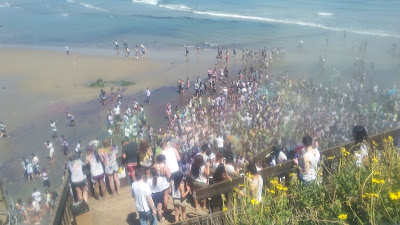
There was one Holi event yesterday and one today - we ended up participating in today's event because it was meant to be the "undergraduate" one, i.e. more party ;) Both events were directly at the beach so we could wash of the color immediately afterwards - but we didn't and walked around as smurves on the beach.That was fun since a lot of people recognized where we had been and commented "That was fun, eh?". Fortunately, after intensive scrubbing the color goes off your skin and I don't feel any damage to my lungs. I got a pair of white shorts and a T-shirt colored for free... and a sunburn, I guess, but that might be some rests of color as well ;)
Just going for a brief run really made my evening:
Or running on the athletics track:
Quite a few people were still around and on the beach. Today we had the first free barbecue outside the Engineering building on campus. The line was huge, but we got typical American burgers and hot-dogs - and finally water melons.
I think I have mentioned the orientation week for international students and the "translation" of American phrases we have learned there. Some of them were:
"How are you?" - "Hello."
"Let's have lunch sometime!" - "Mh, you're a nice person, and we might have lunch... some time... not now!! Maybe in... like... a few months?!"
Probably the same happens in Germany, but if you have to understand another language and deconvolve the meaning with some cultural code, it's not alway straightforward what people mean and I was thankful that I talked to others about it.
There are theories about why Americans try to be very polite; one of them says that so many cultures have to live together without conflicting that you try to be friends with everyone. At the same time, a lot of people come and go, so you have to have an easy, open and friendly way to communicate (and to make new friends).
Continuing the phrases from above:
"I'll think about it." - 99% for "No!"
"You might consider doing xyz." - "I encourage you and you actually should do xyz."
"I don't support it." - "I am absolutely against this."
When you tell someone you study physics and you get the reaction:
"Ooooh...". - "Mh, that's difficult, let's switch topics. But no worries, I won't be too social with you."
"I would love to go!" - "That's nice; I might consider to go."
"I'm okay." (Be careful: This is not "I'm fine", thus usually, something is weird or stressful - that's an important one!) - "I'm not okay."
"This is interesting / has a particular property." - "It's wrong or off or it doesn't taste well."
"We should go and do x sometime!" - (That's similar to the lunch-date:) "We might do x sometime, but ... mmh..."
"Your handwriting is beautiful!" - "Yay, I can read it!!"


